


Everything You Know About GEO Is Wrong


The SEO playbook doesn't work here. The sooner you accept that, the faster you'll figure out what actually does.
GEO is new. Which means there's a lot of bad advice floating around.
Most of it comes from people applying the SEO playbook to a completely different game. They see "optimization" and assume the same tricks work. They don't.
Here are the biggest misconceptions I see — and what's actually true.
Myth #1: "GEO is just SEO for AI"
"It's basically the same thing. Just optimize your content for AI instead of Google."
This is the most common misconception, and it's fundamentally wrong.
SEO is about matching keywords. Someone searches "best CRM software" and you optimize your page to match that query better than anyone else. You're competing to be one of ten links.
GEO is about being trusted enough to be recommended. AI doesn't show a list of links — it synthesizes information and makes recommendations. It's not asking "which page matches this query?" It's asking "what would I recommend to this person?"
That's a completely different question. And it requires a completely different approach.
SEO is about ranking. GEO is about trust. They share some foundations (quality content, authority) but the mechanisms are fundamentally different.
Myth #2: "You can game AI like you game Google"
"There must be tricks — hidden keywords, prompt injections, ways to manipulate what AI says about you."
People spent 20 years figuring out how to game Google. Keyword stuffing. Link farms. Hidden text. And yeah, some of it worked — for a while.
AI is different. Large language models are trained to be helpful, harmless, and honest. They're specifically designed to resist manipulation. They can detect when content is trying to game them rather than genuinely help users.
More importantly, AI doesn't just look at your website. It synthesizes information from across the entire web — reviews, articles, social mentions, expert opinions. You can't control all of that. You can only influence it by actually being good.
AI is harder to game than Google ever was. The only sustainable strategy is being genuinely helpful and building real authority. There's no shortcut.
Myth #3: "Keywords still matter most"
"I just need to find the right AI keywords and optimize for them."
In SEO, keywords are everything. You research what people search, you create content targeting those keywords, you track your rankings for those keywords.
In GEO, people don't use keywords. They ask questions. Real, messy, human questions.
Nobody opens ChatGPT and types "best CRM software small business 2026." They say: "I just started a consulting business and I'm completely overwhelmed by all the software options. What do I actually need to run my business?"
That's not a keyword. That's a conversation. And AI responds to it as a conversation — understanding intent, context, and nuance that keyword-based systems miss entirely.
Think in questions, not keywords. Understand the real problems people are trying to solve, not the search terms they might use.
Myth #4: "If you rank on Google, you'll show up in AI"
"We already rank #1 for our main keywords. We should be fine in AI too."
This assumption is dangerously wrong. And it's causing major brands to be blindsided.
Google ranking is based on backlinks, technical SEO, and keyword optimization. AI recommendations are based on a completely different set of signals — perceived authority, sentiment across sources, how often experts cite you, whether you're seen as genuinely helpful or just good at SEO.
I've seen brands that dominate Google search be completely absent from AI recommendations. And I've seen smaller players with better reputations get mentioned consistently.
Your Google ranking is not predictive of your AI visibility. They're different games with different rules.
Google success doesn't guarantee AI visibility. You need to check both — and you might be surprised by what you find.
Want to see what AI says about your brand right now?
Get a free AI visibility snapshot — we'll show you exactly how ChatGPT, Gemini, and Perplexity talk about your brand today.
Get Your Free AI Snapshot →Myth #5: "GEO is about getting mentioned"
"The goal is to get AI to mention our brand name. Any mention is good."
Getting mentioned is step one. But it's not the goal.
The goal is to be recommended — with positive sentiment, in the right context, for the right use cases. A mention that says "Brand X is one option, but many users complain about their customer service" is not a win. It's a problem.
AI doesn't just mention brands. It evaluates them. It synthesizes reviews, expert opinions, and user experiences into a judgment. And that judgment matters more than the mention itself.
Focus on recommendation quality, not just mention frequency. How you're described matters more than whether you're mentioned.
Myth #6: "It's a technical fix"
"We just need to add some structured data or optimize our schema markup for AI."
SEO has a lot of technical components — site speed, mobile optimization, schema markup, XML sitemaps. People assume GEO must have similar technical levers to pull.
It doesn't. Not really.
AI doesn't care about your schema markup. It doesn't read your robots.txt. It synthesizes information from across the web and forms judgments about who's trustworthy, who's helpful, and who's worth recommending.
That's not a technical problem. It's a reputation problem. A content problem. An authority problem. You can't fix it with code.
GEO is primarily a content and reputation challenge, not a technical one. No amount of technical optimization will make AI trust you more.
Myth #7: "GEO replaces SEO"
"SEO is dead. We should stop doing it and focus entirely on GEO."
SEO is not dead. Not even close.
Google still processes billions of searches daily. Organic traffic still matters. For many queries — especially simple lookups and navigational searches — people will continue using traditional search.
But the landscape is shifting. Complex, high-intent queries are increasingly moving to AI. Research and decision-making conversations are happening in ChatGPT, not Google. The higher the stakes, the more likely people are to want advice, not links.
You need both. SEO for the queries that stay on Google. GEO for the conversations that are moving to AI. Ignoring either leaves you exposed.
GEO doesn't replace SEO — it adds a new channel. The smart play is doing both, and understanding which queries go where.
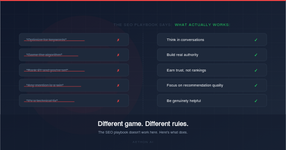
What actually works
If all of that is wrong, what's right? Here's what we've learned actually matters for GEO:
Be genuinely helpful. Not "create helpful content for SEO" helpful. Actually helpful. Answer the real questions people have, not the keywords they search. Solve problems. Educate. Be the resource you'd want to find.
Build real authority. Get cited by experts. Get mentioned in reputable publications. Have customers who talk about you positively. This isn't something you can fake or fast-track — it's earned over time.
Think in conversations, not queries. Understand the messy, uncertain questions people ask when they're figuring things out. Show up for those moments with genuine value.
Monitor what's actually happening. Don't assume. Check what AI is saying about you, your competitors, and your category. The conversation is happening right now whether you're paying attention or not.
Play the long game. There's no trick. There's no shortcut. The brands that win in AI are the ones that deserve to win — because they're actually the best answer to the question being asked.
"The best GEO strategy is being the kind of brand AI should recommend. Everything else is noise."
Forget everything you know about gaming algorithms. This is different. And honestly? That's a good thing. Because it means the winners will be the brands that actually help people — not the ones who are best at manipulation.
The bar just got higher. Rise to meet it.
Book a Demo
See How AI Talks About Your Brand
Get a personalized walkthrough of how Aethon AI tracks, optimizes, and grows your brand’s presence across ChatGPT, Gemini, Perplexity, and more.
Book a Demo →Stay ahead of AI search
Get weekly insights on GEO, AI visibility, and how to show up when AI answers life's big questions. Join marketers and founders who are already optimizing for the AI era.
Subscribe to the Newsletter →