


GEO vs SEO: What’s the Difference and Why It Matters


SEO got us all obsessed with keywords. GEO is about something different: understanding the questions people actually ask and making sure you’re part of the answer.
The quick answer
SEO (Search Engine Optimization) is about ranking higher in Google’s list of links. You optimize for keywords, build backlinks, and try to be one of the ten blue links people see when they search. GEO (Generative Engine Optimization) is about being recommended by AI assistants like ChatGPT, Perplexity, Gemini, and Claude. You optimize for being mentioned in conversations, cited as a trusted source, and recommended when people ask for advice. Same goal — getting found. Completely different game.How SEO actually works
For two decades, SEO has been the dominant playbook for digital visibility. The basic mechanics: Someone types a query into Google. Google’s algorithm scans billions of pages and ranks them based on relevance, authority, and hundreds of other signals. You see a list of links. You click one. Maybe you find what you’re looking for. Maybe you go back and try another link. To win at SEO, you need to:- Target keywords — Figure out what people are searching for and create content that matches those queries
- Build authority — Get other sites to link to yours (backlinks), establish domain authority
- Optimize technically — Fast load times, mobile-friendly, proper meta tags, structured data
- Create content — Blog posts, landing pages, guides that target your keywords
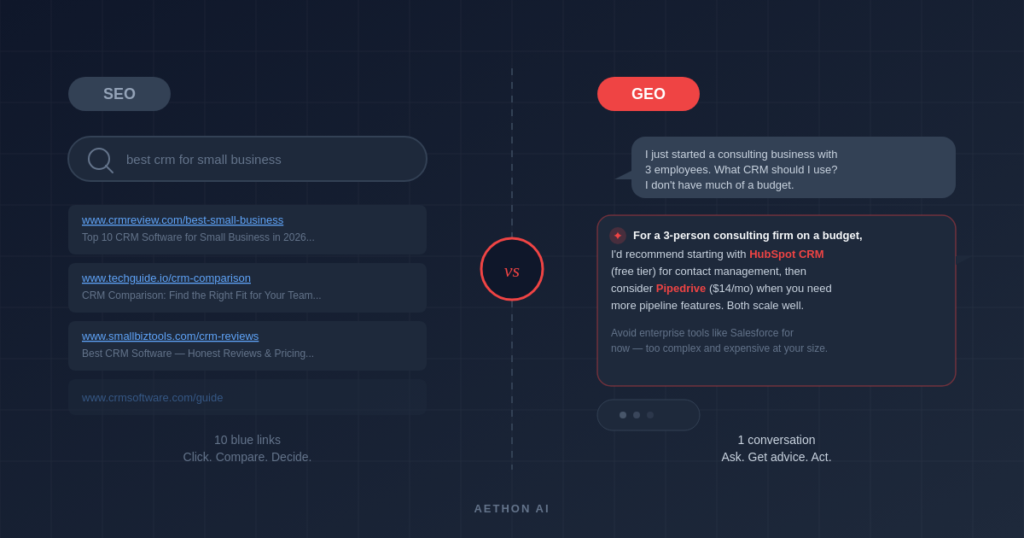
SEO in action
User searches: “best CRM for small business”
Google shows: 10 blue links to articles, product pages, review sites
User: clicks through several links, compares options, forms opinion
How GEO actually works
GEO operates in a fundamentally different environment. There’s no list of links. There’s a conversation. Someone opens ChatGPT and asks a question — not a keyword, but a real question in natural language. The AI synthesizes information from its training data and (increasingly) real-time web sources to generate a response. That response might mention specific brands, recommend specific products, or point the person toward specific resources.GEO in action
User asks: “I just started a consulting business with 3 employees. What CRM should I use? I don’t have much of a budget but I need something that can grow with me.”
AI responds: Synthesized recommendation mentioning 2-3 specific options with reasoning
User: Takes the advice, maybe asks follow-up questions
“SEO answers the question ‘what results match this keyword?’ GEO answers the question ‘what would I recommend to this person?'”
Want to see what AI says about your brand right now?
Get a free AI visibility snapshot — we’ll show you exactly how ChatGPT, Gemini, and Perplexity talk about your brand today.
Get Your Free AI Snapshot →The key differences
| SEO | GEO | |
|---|---|---|
| Input | Keywords (“best crm software”) | Conversations (“I need help choosing a CRM for my situation”) |
| Output | List of links to click | Direct answer with recommendations |
| User behavior | Browse, compare, decide | Ask, receive advice, act |
| Trust level | Skeptical (ads, SEO gaming) | High (feels like personal advice) |
| Optimization target | Ranking position (#1-10) | Being mentioned and recommended |
| Success metric | Clicks, traffic | Mentions, sentiment, recommendation rate |
| Content strategy | Keyword-targeted pages | Authoritative, helpful information |
| Timeline | Transactional (ready to buy) | Full journey (including early exploration) |
Why GEO isn’t replacing SEO
Let’s be clear: SEO isn’t going away. Google still processes billions of searches daily. People still click links. Organic traffic still matters. But the landscape is shifting. A growing percentage of searches — especially complex, high-intent queries — are moving to AI assistants. And this trend is accelerating. Think of it this way:- Simple lookups (“weather in Chicago”) → Still mostly Google
- Quick facts (“when was the Eiffel Tower built”) → Split between Google and AI
- Research and decisions (“what laptop should I buy for video editing”) → Increasingly AI
- Complex, personal questions (“I just got diagnosed with diabetes, what should I know”) → Heavily AI
“You need both SEO and GEO. But if you’re only doing SEO, you’re invisible in a growing number of the conversations that matter most.”
What this means for your brand
If you’ve built your entire digital strategy around SEO, you’re not starting from zero with GEO — but you do need to think differently. From keywords to questions. SEO trained us to think in keywords. GEO requires thinking in questions — and not just any questions, but the messy, real, uncertain questions people ask when they’re figuring something out. “Best CRM software” is a keyword. “I just started a business and I’m overwhelmed by all the software options — what do I actually need?” is a question. From ranking to recommending. In SEO, you want to rank #1. In GEO, you want to be the brand that gets recommended. That’s not about gaming an algorithm — it’s about genuinely being the best answer to someone’s question. AI can tell the difference between helpful content and keyword-stuffed pages. From traffic to trust. SEO measures clicks. GEO measures whether people trust you enough to recommend you. That trust is built over time, across many touchpoints, and it shows up in how AI systems talk about your brand. From pages to presence. SEO is about optimizing individual pages. GEO is about your overall presence — how you’re discussed across the web, what people say about you, whether you’re seen as an authority in your space. It’s more holistic. First step: Find out where you stand. Before you can optimize for GEO, you need to know what AI is currently saying about you. Open ChatGPT, Perplexity, Gemini, and Claude. Ask the questions your customers ask. See if you’re mentioned. See who is. That’s your starting point. That’s the conversation happening right now — whether you’re part of it or not.Frequently asked questions
What is the difference between GEO and SEO?
SEO is about ranking higher in Google’s list of links by targeting keywords and building backlinks. GEO is about being recommended by AI assistants like ChatGPT, Perplexity, Gemini, and Claude when people ask for advice. SEO matches keywords. GEO earns recommendations.Is GEO replacing SEO?
No. Google still processes billions of searches daily and SEO still matters. But complex, high-intent queries are increasingly moving to AI assistants. Brands need both SEO and GEO to stay visible across the full range of how customers search.What does GEO stand for?
GEO stands for generative engine optimization. It’s the practice of monitoring and improving how your brand appears in AI-generated answers from platforms like ChatGPT, Perplexity, Gemini, and Claude.How do I get started with GEO?
Start by finding out where you stand. Open ChatGPT, Perplexity, Gemini, and Claude. Ask the questions your customers ask. See if your brand is mentioned and who gets recommended instead. That’s your baseline. From there, focus on creating helpful, authoritative content that answers real questions.What is a GEO platform?
A GEO platform automates the process of tracking your brand’s visibility across AI assistants. Instead of manually typing prompts into ChatGPT and Perplexity, a GEO platform monitors how AI recommends your brand, tracks competitors, measures changes over time, and shows you what to do to improve.Book a Demo
See How AI Talks About Your Brand
Get a personalized walkthrough of how Aethon AI tracks, optimizes, and grows your brand’s presence across ChatGPT, Gemini, Perplexity, and more.
Book a Demo →Stay ahead of AI search
Get weekly insights on GEO, AI visibility, and how to show up when AI answers life’s big questions. Join marketers and founders who are already optimizing for the AI era.
Subscribe to the Newsletter →