


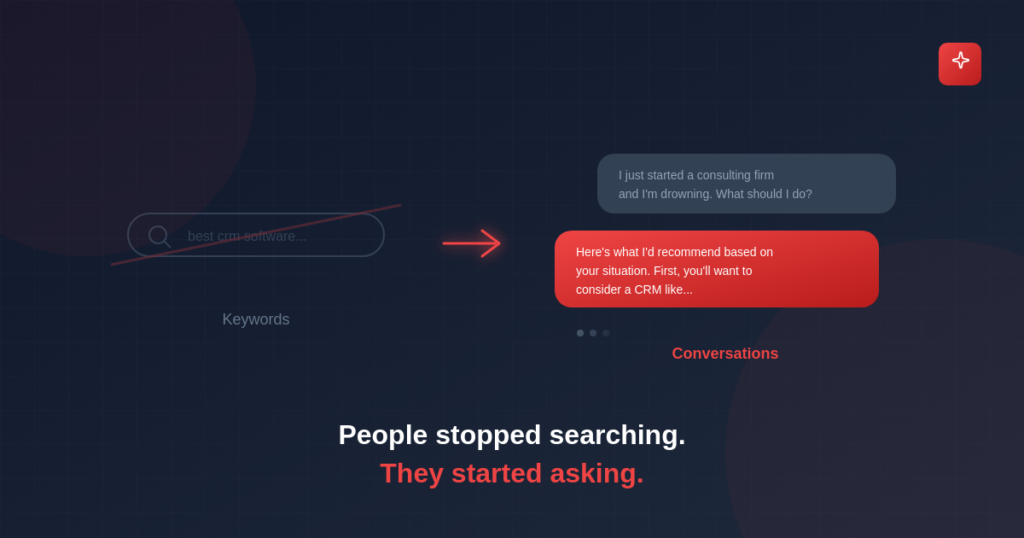
People Stopped Searching. They Started Asking.


Something changed in how people find things online. And most brands haven't noticed yet.
For twenty years, the playbook was simple: figure out what people are searching for, optimize your content for those keywords, and show up in Google's results. It worked. Entire industries were built on it.
But that's not how your customers behave anymore.
Instead of typing "best CRM for small business" into a search bar, they're opening ChatGPT and saying: "I just started a consulting firm and I'm drowning in spreadsheets. What should I do?"
That's not a search. That's a conversation. And the difference matters more than most marketers realize.
The shift from keywords to conversations
When someone searches Google, they use keywords. Short, transactional, optimized for the algorithm. "Best plumber near me." "CRM pricing." "Lawyer for car accident."
When someone talks to AI, they speak like a human. They share context. Then they explain their situation. They ask for advice.
"We just bought our first house, and the basement floods every time it rains. What should we know before calling someone?"
"My doctor mentioned I might need a knee replacement. What questions should I be asking?"
"I'm turning 40 and I've never really thought about retirement. Where do I even start?"
These aren't searches. These are the moments before the search — when someone is still figuring out what they need, who to trust, and what questions to ask.
Why this matters for your brand
Here's the thing about those early conversations: they shape everything that comes after.
When someone asks ChatGPT about knee replacements, the AI doesn't just answer the question. It frames how that person thinks about the entire decision. The response suggests what to look for in a surgeon. Next, it explains what questions to ask. It might even recommend specific practices or approaches.
By the time that person searches Google or calls a doctor's office, their mind is already half-made. The AI shaped their expectations, their criteria, their shortlist.
"If your brand wasn't part of that early conversation, you're starting from behind. You're competing on price and availability instead of trust and authority."
AI recommendations feel like advice — ads don't
Think about the last time you asked a friend for a recommendation. Maybe a restaurant, a contractor, a doctor. When they gave you a name, you probably trusted it. You didn't need to see reviews or compare five options. Someone you trusted said "go here," and that was enough.
AI recommendations work the same way. When ChatGPT suggests a solution, it doesn't feel like an ad. It feels like advice from a knowledgeable friend who has no reason to lie to you.
That's why AI-referred traffic converts differently. These aren't cold clicks from a search results page. These are warm introductions from a source the customer already trusts.
You can't buy that kind of trust. You have to earn it — by being the brand that AI learns to recommend.
Want to see what AI says about your brand right now?
Get a free AI visibility snapshot — we'll show you exactly how ChatGPT, Gemini, and Perplexity talk about your brand today.
Get Your Free AI Snapshot →What AI looks for when it recommends a brand
AI doesn't recommend brands the way Google ranks websites. There's no simple algorithm to game, no keyword density to optimize.
Instead, AI models form impressions based on the information they've been trained on and the sources they can access. They look for signals like:
- Authority: Are you cited by credible sources? Do experts reference your work?
- Consistency: Does your brand show up reliably across contexts, or are you invisible in certain conversations?
- Helpfulness: Does your content actually answer the questions people are asking, or is it just optimized for keywords?
- Trust signals: Reviews, testimonials, third-party validation, press coverage — the same things that make humans trust you make AI trust you.
The brands that win in AI search are the ones that have been building trust for years — often without realizing they were optimizing for this moment.
The opportunity for brands that move early
We're still in the early days of this shift. Most brands haven't even started thinking about AI visibility. They're still focused on Google rankings and paid ads, fighting over the same expensive keywords they've always fought over.
That's the opportunity.
The brands that figure out AI visibility now — while their competitors are still asleep — will own the conversations that matter. They'll be the default recommendation. The trusted name. The one AI suggests before anyone else.
And by the time everyone else catches on, it'll be much harder to catch up.
Where to start
The first step is simple: find out what AI is saying about you right now.
Open ChatGPT, Perplexity, Gemini, or Claude. Ask the questions your customers ask. "What's the best [your category] for [your customer's situation]?" See what comes back. See if you're mentioned. See who is.
That's your baseline. That's the conversation happening right now, whether you're in it or not.
The question is: what are you going to do about it?
Book a Demo
See How AI Talks About Your Brand
Get a personalized walkthrough of how Aethon AI tracks, optimizes, and grows your brand’s presence across ChatGPT, Gemini, Perplexity, and more.
Book a Demo →Stay ahead of AI search
Get weekly insights on GEO, AI visibility, and how to show up when AI answers life's big questions. Join marketers and founders who are already optimizing for the AI era.
Subscribe to the Newsletter →