


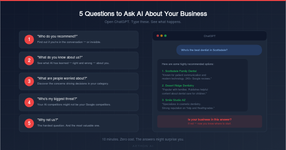
5 Questions Every Small Business Should Ask AI About Themselves Right Now


This takes 10 minutes. It costs nothing. And what you find might change how you think about your marketing entirely.
The conversation you're not hearing
It's 11pm on a Tuesday. A woman just moved to your city. Her kid fell off a bike and chipped a tooth. She's not opening Google and comparing ads. She's lying in bed, opening ChatGPT, and typing:
"My 7-year-old just chipped his front tooth. What should I do? Can you recommend a good pediatric dentist near me?"
That's not a search. That's a conversation. A real person, in a real moment, asking for help.
And AI answers. With names. Complete with reasons. With the kind of specific, personalized guidance that feels less like a search result and more like a recommendation from a friend who happens to know everything about dentists in Scottsdale.
Your name is either in that conversation or it's not. And right now, you probably have no idea which one it is.
That changes in the next 10 minutes. Open ChatGPT — or Perplexity, or Claude, ideally all three — and ask these five questions.
1 "Who do you recommend?"
Start with the question your customers are actually asking.
But here's the thing — don't ask it the way a marketer would. Ask it the way a real person would. Because that's what's actually happening out there. People aren't typing keywords into AI. They're describing their life.
"We just moved to Scottsdale with two kids. We need a family dentist that's good with children and takes Cigna. Any recommendations?"
Not "best dentist Scottsdale." That's a Google search. The prompt above is an AI conversation — and the answers are completely different.
When someone tells AI about their situation — their kids, their insurance, the fact that they just moved — AI doesn't just return a list. It recommends. Then it explains why. It matches the recommendation to the specific situation.
Now try a few variations. Each one reveals a different slice of how AI sees your market:
"I haven't been to the dentist in 5 years because I have really bad anxiety about it. Can you recommend someone in Scottsdale who's known for being gentle with nervous patients?"
"My mom is 78 and just moved in with us. She needs a dentist who works with elderly patients and can handle some complex dental issues. Who's good in Scottsdale?"
Each of these is a life moment. A new family in town. Someone overcoming a fear. An adult child taking care of a parent. These are the conversations happening in AI right now — and they're far more specific than anything that happens on Google.
What to look for
Are you in any of these answers? Try three or four variations. Maybe you show up for the general question but not the anxiety one. Maybe you show up for elderly care but not pediatric. Each gap tells you something specific about how AI perceives you.
Who keeps showing up? Write down every name. These are your AI competitors — and they might surprise you. The businesses winning in AI aren't always the biggest or the ones spending the most on ads. They're often the ones with the best reviews, the most helpful content, and the clearest specialties.
Why does AI recommend them? Pay close attention to the reasoning. "Known for patient communication." "Great with anxious patients." "Extensive experience with pediatric care." These aren't random — they're the exact signals AI is using to match businesses to moments. That tells you what you need to be known for.
If AI recommends a competitor you know isn't as good as you — that's not AI being wrong. That's AI reflecting a digital presence that's stronger than yours. They're not better. They're more visible. That's a solvable problem.
2 "What do you know about us?"
Now let's get personal.
"What can you tell me about [your business name] in [your city]? What are they known for? What do patients/clients say about them?"
This reveals your AI reputation. Not your Google ranking, not your ad performance — what AI has actually synthesized about you from everything it can find online.
What to look for
Does AI know you exist? If ChatGPT says "I don't have specific information about that business" — that's your reality check. Your digital footprint isn't strong enough for AI to have any opinion about you at all. You're not even a blank page. You're invisible.
Is it accurate? Check everything. Your specialties, your location, what you're known for. AI sometimes gets things confidently wrong — outdated information, confused identities, old addresses. If it's wrong, that's what your potential customers are hearing about you right now.
What's the tone? Positive? Neutral? Does it flag negatives? AI pulls from reviews, articles, mentions, social — everything. The sentiment it reflects is a mirror of your online reputation.
What's missing? This one stings. Maybe you're the only practice in town with a sedation dentistry program. But AI doesn't mention it. Why? Because there isn't enough content online connecting your name to that specialty. AI can only know what it can find.
The gap between what you are and what AI thinks you are? That's not a branding problem. It's a content problem. Every missing specialty, every strength AI doesn't know about — that's a piece of content that doesn't exist yet.
3 "What are people worried about?"
This is where it gets really valuable. Because this question doesn't just tell you what AI thinks — it tells you what your future customers are feeling before they ever type your name.
"What are people most worried about when choosing a [your category]? What do they wish they knew before making a decision?"
What comes back is essentially a window into your customers' heads. Not what they search for — what they feel. The fears. Their uncertainties. The things keeping them up at night before they even start looking for someone like you.
"Will it hurt?"
"How do I know they're not going to overcharge me?"
"Are they good with kids who are scared?"
"What if I haven't been in years and my teeth are a mess?"
These aren't keywords. These are human moments. And the businesses that create content addressing these exact worries — genuinely, in plain language, without a sales pitch — are the ones AI learns to trust and recommend.
What to look for
Which concerns surprise you? Your customers often worry about things you'd never think of. Those surprises are your biggest content opportunities.
Which concerns do you already address? Make sure that content is easy to find. If you have a whole approach to dental anxiety but it's buried on page four of your website, AI might never see it.
Which concerns do you not address anywhere? Each one is a blog post waiting to be written. Not a sales pitch — a genuinely helpful answer to a real human concern. One piece of content like that is worth more than ten "we're proud to announce" posts.
"The best marketing strategy for AI is embarrassingly simple: answer the questions people are actually asking, in the language they're actually using."
Want to see what AI says about your brand right now?
Get a free AI visibility snapshot — we'll show you exactly how ChatGPT, Gemini, and Perplexity talk about your brand today.
Get Your Free AI Snapshot →4 "Who's my biggest threat?"
You know your competitors in real life. But AI has a completely different leaderboard.
"If someone in [your city] asked you to recommend the top 3 [your category], who would you say and what makes each one stand out?"
What to look for
The reasoning. AI explains why it recommends each business. "Known for their modern technology." "Outstanding patient reviews." "Specializes in anxious patients." Each reason tells you what's working for someone else in your market.
Patterns. If all three recommended businesses have tons of reviews, active blogs, and community involvement — that's table stakes. That's the minimum to be in the conversation.
Gaps. Maybe none of the recommended businesses are known for what you're known for. That's your opening. If nobody in the AI conversation owns "sedation dentistry for anxious adults" and that's your thing — that position is wide open. You don't need to beat them. You need to own a lane they're not in.
Surprises. Sometimes AI recommends a business you've never thought of as a competitor. A solo practice with incredible reviews. A newer business with helpful content. That tells you the competitive landscape in AI is different from Google. Different signals, different winners.
Now try the same question framed as a life moment:
"My family just moved to Scottsdale. We have a 4-year-old and a 9-year-old. We need a dentist the whole family can go to. Who would you recommend?"
The answers might be completely different from the generic "top 3" question. That's the point. When AI has context — real human context — it narrows its recommendations. The question is whether it narrows toward you or away from you.
5 "Why not us?"
The hardest question. And the most valuable.
"I'm considering [your business name] for [your service]. What should I know? Are there any concerns or things to think about?"
Take a breath before you read the answer.
What to look for
What negatives surface? If AI mentions bad reviews, limited hours, or missing services — that's what people are hearing about you. Even if you've already fixed the issue, AI might still be telling your potential customers about it.
What doesn't it mention? If AI has nothing to say — no positives, no negatives, just "I don't have enough information" — that's the worst outcome. A business with some negatives is still in the conversation. A business AI doesn't know about isn't in the room at all.
The gap. Compare what AI says to what you know about yourself. This is where most business owners get hit. They know they're great at what they do. Their patients love them. Their clients refer them. But AI doesn't know any of that — because it's not reflected in their digital presence.
The gap between how good you are and how visible you are? That's the entire opportunity.
"The question isn't whether you're the best. It's whether AI knows you're the best."
What to do with the answers
You've spent 10 minutes. You now know more about your AI visibility than 95% of small businesses. Here's what to do next.
If you're invisible
Don't panic. Most small businesses aren't showing up yet. The window to get ahead is wide open. Start simple: complete your Google Business Profile, start consistently asking happy customers for reviews, and write one piece of content a month that answers a real concern from Question 3. That's your starting play.
If you're mentioned but not recommended
AI knows you exist but isn't excited about you. Look at who it does recommend and ask why. Usually it comes down to three things: more reviews, more helpful content, or more mentions on other sites. Pick one and start there.
If the information is wrong
More common than you'd think. Update your website, Google profile, and directory listings. Create content that clearly states what you do, where you are, and what you specialize in. AI picks up corrections over time.
If a competitor is dominating
Study what they're doing — not to copy them, but to understand the signals. 300 reviews to your 40? That's an action item. Weekly blog content to your zero? Action item. You don't need to outspend them. You need to out-help them.
Do this again next month
AI changes. New reviews get factored in. New content gets picked up. What AI says about you today won't be the same in 30 days. Make this a monthly habit. Same five questions. Note what changed. Ten minutes a month to stay aware of the conversation happening about your business.
Start here
These five questions are a snapshot. A 10-minute look at a conversation that's happening about your business every single day, in moments that matter — late at night, after a move, after a diagnosis, after a pipe bursts.
People are bringing their real lives to AI and asking for help. And AI is recommending specific businesses. The question is whether yours is one of them.
Now you know how to find out. Start there.
Book a Demo
See How AI Talks About Your Brand
Get a personalized walkthrough of how Aethon AI tracks, optimizes, and grows your brand’s presence across ChatGPT, Gemini, Perplexity, and more.
Book a Demo →Stay ahead of AI search
Get weekly insights on GEO, AI visibility, and how to show up when AI answers life's big questions. Join marketers and founders who are already optimizing for the AI era.
Subscribe to the Newsletter →