


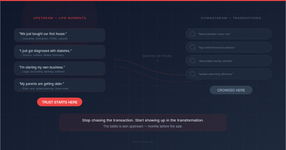
Stop Chasing “Best X Near Me” — Start Showing Up in Life Moments


Every brand is fighting for the same transactional keywords. The smart ones are showing up earlier — in the AI conversations happening during life moments, where trust is built months before the sale.
Why “best X near me” is a losing strategy
Open any marketing dashboard and you’ll see it: every brand in your industry is fighting for the same keywords. “Best CRM software.” “Top-rated plumber near me.” “Affordable family dentist.”
These are transactional queries — the moment someone has already decided what they need and is actively shopping. It’s also the most expensive, competitive, and crowded place in digital marketing.
“By the time someone searches ‘best X near me,’ you’re competing with everyone. The battle for that customer’s trust was won — or lost — much earlier.”
Here’s the problem most brands miss: by the time someone types “best personal injury lawyer near me” into Google, they’ve already narrowed their consideration set. They’ve already formed opinions about what matters. They’ve already heard recommendations from friends, family, or — increasingly — AI assistants like ChatGPT, Perplexity, and Claude.
The brands winning in 2026 aren’t fighting harder for these bottom-of-funnel keywords. They’re investing in generative engine optimization (GEO) — showing up earlier in the AI-powered conversations that shape customer decisions long before the transaction.
What are life moments in marketing?
People don’t wake up thinking about products and services. They wake up thinking about their lives — their kids, their health, their careers, their relationships, their futures.
At certain inflection points, everything changes. These are life moments: the major transitions that trigger new needs, shift priorities, and set off chains of decisions that ripple for months or years. Buying a first home. Having a baby. Getting a diagnosis. Starting a business. Losing a job.
Life moments aren’t transactional. They’re transformational. And they’re where the real opportunity for AI visibility lies.
The life moment always happens first — often months or years before the transaction. And increasingly, people are processing these moments by talking to AI. They’re asking ChatGPT and Perplexity for advice, guidance, and recommendations during the most important transitions of their lives.
Upstream vs. downstream: where trust is really built
Think of the customer journey like a river. At the bottom — downstream — is the transaction, the moment money changes hands. That’s where most marketing budgets go: Google Ads, SEO for high-intent keywords, retargeting campaigns.
But upstream is where the river forms. It’s where small tributaries of life events, concerns, and questions converge into purchase intent. It’s where someone goes from “I’m worried about my parents” to “I need an estate planning attorney” — and it happens over weeks and months, not in a single search.
The brand that’s present upstream — answering questions, building trust, and being genuinely helpful in AI conversations — is the brand that gets the call when the customer is finally ready to buy.
“The AI recommendation that happens 18 months before the sale is worth more than all the Google Ads in the world. That’s upstream marketing — and it’s the foundation of generative engine optimization.”
This is why fighting for “best X near me” is a losing strategy in the age of AI search. You’re showing up at the end of a customer journey that started without you. The winner was decided upstream — when someone opened ChatGPT, described their life situation, and got an answer that mentioned a specific brand.
Want to see what AI says about your brand right now?
Book a demo and we’ll show you exactly how ChatGPT, Gemini, and Perplexity talk about your brand today.
How AI search changes the customer journey
Here’s what’s fundamentally different about customer behavior in 2026: people have a new place to process life moments. Instead of just thinking, worrying, or asking friends, they’re opening ChatGPT, Perplexity, Gemini, and Claude — and having real, detailed conversations about their lives.
“I just found out I have high blood pressure. What should I know?”
“My company is going through layoffs and I’m nervous about my job security.”
“We’re thinking about moving to Austin. What’s it really like to live there?”
These aren’t keyword searches. They’re conversations — full of context, emotion, and nuance. And in these conversations, AI is synthesizing everything it knows to give recommendations, suggest resources, and mention brands that it associates with authority, helpfulness, and trust.
This is generative engine optimization in action. The brands that have built genuine authority around these life moments are the ones AI recommends. If you’re not part of that conversation, you’re invisible during the most influential part of the customer journey — the part that happens before anyone searches Google.
Why AI recommendations convert differently
When ChatGPT recommends a brand during a life moment conversation, it doesn’t feel like an ad. It feels like advice from a knowledgeable friend. That’s why AI-referred customers convert at higher rates — they arrive pre-qualified, pre-trusting, and pre-disposed to choose the recommended option. No amount of keyword bidding can replicate that level of trust.
Life moment examples by industry
Every industry has life moments that precede transactions. Understanding your customer’s upstream moments is the first step in any AI visibility or GEO strategy. Here are examples across sectors:
The brands that understand these upstream moments — and show up with helpful, authoritative information when people are processing them in AI conversations — build trust that no amount of bottom-funnel advertising can buy.
How to show up in AI conversations before the transaction
Showing up during life moments requires a different approach than traditional SEO or keyword marketing. Here’s a practical GEO framework for upstream visibility:
1. Identify your upstream life moments
What life events happen before someone needs your product or service? Go back 6 months, 12 months, even 2 years. What was happening in their life that would eventually lead them to you? Map those moments — they’re your highest-value GEO targets.
2. Understand the questions people ask AI
When people are in these life moments, what do they want to know? Not about your product — about their situation. What are they confused about? Worried about? Curious about? These are the conversational queries you need to appear in.
3. Build authority around those questions
Create content that genuinely helps people navigate these moments. Not sales content — helpful, expert content. The kind of content that AI systems recognize as authoritative and useful when recommending solutions. Think guides, frameworks, and honest answers to the questions people are too embarrassed to ask their friends.
4. Monitor your AI visibility
What are AI platforms actually saying when people ask about these life moments? Is your brand being mentioned? Are your competitors? Are there conversations where no brand shows up at all — wide-open opportunities you’re missing?
The goal isn’t to trick AI into recommending you. It’s to be genuinely helpful during the moments that matter most — and to build the kind of authority that leads to natural recommendations from ChatGPT, Perplexity, Gemini, and Claude.
“Stop chasing the transaction. Start showing up in the transformation. That’s the core principle of generative engine optimization.”
The brands that understand this are already winning. They’re not fighting for “best X near me.” They’re showing up in the life moments that happen months before — building trust, offering genuine value, and becoming the obvious choice when the transaction finally arrives.
The question is: where does your customer’s journey really begin? And are you there?
Frequently asked questions
What are life moments in marketing?
Life moments are major inflection points in a customer’s life — buying a house, having a baby, starting a business, getting a health diagnosis — that trigger new needs and decisions. They happen months or years before a transactional search and are where brand trust actually begins. In the AI era, people process these moments by talking to ChatGPT, Perplexity, and other AI assistants.
Why is “best X near me” a losing marketing strategy?
By the time someone searches “best X near me,” they’ve already narrowed their consideration set based on earlier conversations and recommendations — increasingly from AI. You’re competing on price and availability instead of trust. The brands that showed up during upstream life moments in AI conversations already have the advantage.
How do brands show up in AI recommendations?
AI models recommend brands based on authority, consistency, helpfulness, and trust signals — not keyword bids. This is the core of generative engine optimization (GEO). Brands that create genuinely helpful content around the life moments and questions their customers face are more likely to be recommended by ChatGPT, Perplexity, Gemini, and Claude.
What is upstream marketing in the context of AI search?
Upstream marketing means showing up early in the customer journey — during the life moments and exploratory conversations that happen long before someone is ready to buy. In the AI era, this means being the brand that AI recommends when someone is processing a life change, not just when they’re comparing prices.
What is generative engine optimization (GEO)?
Generative engine optimization (GEO) is the practice of improving a brand’s visibility across AI-powered search platforms like ChatGPT, Perplexity, Gemini, and Claude. Unlike traditional SEO which focuses on Google rankings, GEO focuses on building the authority, trust, and helpfulness signals that AI models use when making recommendations during customer conversations.
Stay ahead of AI search
Get weekly insights on GEO, AI visibility, and how to show up when AI answers life’s big questions. Join marketers and founders who are already optimizing for the AI era.