


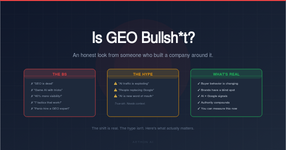
Is GEO Bullsh*t? Let's Get Real.


I need to talk to you about something.
There's a new acronym making the rounds: GEO — generative engine optimization. And depending on who you ask, it's either the most important shift in marketing since Google existed — or it's complete bullsh*t invented by consultants who need something new to sell.
Here's the thing: I built an entire company around this stuff. So you'd expect me to tell you GEO is the future, SEO is dead, and you need to optimize for AI or your business will collapse.
I'm not going to do that.
Because honestly? Some of what's being said about GEO is bullsh*t. And if you're going to trust me with your time (or eventually your money), I figure you deserve the truth.
So let me break down what's real, what's hype, and what actually matters.
The Bullsh*t Side of Generative Engine Optimization
Let's start with what's not true. Because there's a lot of noise out there, and some of it is embarrassingly wrong.
🚩 BS Claim #1: "SEO is dead. GEO is all that matters now."
No. Just no. Google still processes 8.5 billion searches per day. SEO isn't dead — it's just not the only game in town anymore. Anyone telling you to abandon SEO for GEO is either ignorant or trying to sell you something.
🚩 BS Claim #2: "You can 'optimize' your way into AI recommendations."
This is the SEO playbook being lazily applied to a completely different system. AI doesn't work like Google. There's no keyword density trick, no backlink scheme, no meta tag magic that's going to game ChatGPT. AI systems are specifically designed to resist manipulation. If your strategy is "gaming AI" — good luck with that.
🚩 BS Claim #3: "Add these 7 GEO tactics and watch your AI visibility soar!"
Most of the "generative engine optimization tactics" being sold are just... content marketing. Write good content. Be helpful. Cite sources. Structure your information clearly. This isn't revolutionary — it's what good marketers have been doing for decades. Slapping "GEO" on it doesn't make it new.
🚩 BS Claim #4: "GEO will give you 40% more visibility!"
This stat comes from a legitimate academic paper from Princeton and Georgia Tech. But it's been wildly misrepresented. The research showed that certain optimization techniques can improve visibility in AI responses by up to 40% — in controlled experimental conditions. That's not the same as "do these things and your traffic goes up 40%." Context matters.
🚩 BS Claim #5: "You need a GEO agency/consultant/platform or you'll be invisible."
Fear sells. But the reality is more nuanced. Yes, AI is changing how people find information. No, you don't need to panic-hire a "GEO expert" who just learned the acronym last month. Most of the fundamentals — good content, real expertise, genuine authority — haven't changed.
If someone's selling you GEO as a quick fix or a secret formula, they're selling you snake oil. Period.
The GEO Hype (That Has a Kernel of Truth)
Now let's talk about the claims that aren't exactly wrong — but are being overblown.
"AI traffic is growing exponentially!"
True-ish. AI referral traffic to websites has grown dramatically. Some reports show 527% growth in AI-referred sessions in early 2025. ChatGPT now processes billions of queries.
But let's add context: AI referral traffic is still only about 1% of total web traffic for most sites. It's growing fast, but from a tiny base. This matters — it's worth paying attention to — but it's not the apocalypse some people are describing.
"People are replacing Google with ChatGPT!"
Some people are. For some queries. Research suggests 58% of users have used AI tools instead of search engines for product research. That's significant.
But "instead of" and "in addition to" are different things. Most people are adding AI to their information diet, not replacing everything else. Google still dominates. Your SEO still matters. The sky isn't falling.
"AI recommendations are the new word of mouth!"
There's something to this. When ChatGPT recommends a product or service, it feels different than a search result. It feels like advice from a trusted friend. That's powerful.
But we should be careful about overstating how much influence these recommendations have. People don't blindly follow AI suggestions any more than they blindly follow everything Google shows them. Trust is earned, not automated.
What's Actually Real About GEO & Generative Engine Optimization
Okay, so if a lot of the GEO hype is overblown, why did I build a company around this?
Because underneath all the noise, there are some things that are genuinely true — and genuinely important.
✅ Real Thing #1: Buyer behavior is actually changing.
This isn't speculation. People are asking AI for recommendations. Not everyone, not for everything — but enough people, for enough things, that it matters. 89% of B2B buyers now consider AI search in their buying process. That's not a future prediction. It's happening now.
✅ Real Thing #2: Most brands have no idea what AI says about them.
Ask 100 CMOs what ChatGPT recommends when someone asks about their category. Maybe 5 of them know the answer. The other 95 have never even thought to check. That's a real blind spot, and it's only going to matter more over time.
✅ Real Thing #3: AI visibility is different from search visibility.
A brand can rank #1 on Google and never get mentioned by ChatGPT. The signals are different. And the systems have changed entirely. What makes Google trust you (backlinks, technical SEO, domain authority) isn't necessarily what makes AI trust you (authority, sentiment, helpfulness, how you're talked about across the web).
✅ Real Thing #4: This compounds over time.
AI systems learn from what's written about you. If you build authority now, that gets baked into how AI describes you going forward. If your competitor builds authority and you don't, that gap widens. Early movers have an advantage that's hard to overcome later.
✅ Real Thing #5: You can actually measure this now.
A year ago, tracking AI visibility was basically impossible. Now there are tools, methods, and data sources. You can see what AI says about you. Compare yourself to competitors. Track changes over time. This isn't squishy — it's measurable.
Want to see what AI says about your brand right now?
Get a free AI visibility snapshot — we'll show you exactly how ChatGPT, Gemini, and Perplexity talk about your brand today.
Get Your Free AI Snapshot →The Uncomfortable Middle Ground on AI Visibility
Here's what I actually believe:
Generative engine optimization isn't bullsh*t. But it's also not the revolution some people are selling. It's a real shift that's worth paying attention to — but it's early, it's evolving, and anyone claiming to have all the answers is lying to you.
SEO isn't dead. But it's not enough anymore either. If your entire strategy is "rank on Google," you're increasingly betting on yesterday's game. The smart play is both/and, not either/or.
You can't game AI. But you can understand it. You can see what it says about you. And understand why. Then you can make strategic decisions based on that understanding.
Most "GEO tactics" are just good marketing. But that doesn't mean the underlying shift isn't real. The fundamentals haven't changed — be genuinely helpful, build real authority, create content people actually want. What's changed is where that content needs to show up.
The question isn't "Should I do GEO instead of SEO?" The question is "What's my strategy for showing up in the places my customers are actually looking?"
So What Should You Actually Do About Generative Engine Optimization?
Here's my honest advice, stripped of all the hype:
1. Start by just looking.
Ask ChatGPT, Perplexity, and Claude what they recommend in your category. See if you're mentioned. Check who is. This costs you nothing but 10 minutes, and the answers might surprise you.
2. Don't panic.
If you're not showing up in AI responses right now, that's okay. Most brands aren't. You're not dying. And you're not doomed. You just have an opportunity to get ahead while your competitors are still ignoring this.
3. Don't abandon what's working.
If your SEO is driving results, keep doing it. If your content marketing is working, keep doing it. Generative engine optimization doesn't replace these things — it adds to them.
4. Think about reputation, not tricks.
AI visibility isn't about optimization hacks. It's about how you're perceived across the internet. Your reviews matter. So do your mentions. And your helpfulness matters most of all. What people write about you matters. Focus on being the kind of brand that deserves to be recommended.
5. Start measuring.
You can't manage what you don't measure. Start tracking where you show up in AI responses. Set a baseline. Check it monthly. Note what changes and why.
6. Play the long game.
AI visibility compounds. The authority you build today influences how AI talks about you tomorrow. This isn't a quick win — it's a strategic investment.
TL;DR — Is GEO Bullsh*t?
- The acronym? Kinda. It's marketing jargon for a real phenomenon.
- The consultants selling "GEO services"? Some are legit. Many are just repackaging content marketing.
- The underlying shift? Real. People are using AI differently than search. That matters.
- The panic? Overblown. This is a gradual shift, not an overnight apocalypse.
- The opportunity? Genuine. Brands that figure this out early will have an advantage.
My Verdict
Generative engine optimization as a buzzword? Yeah, it's a little bullsh*t-adjacent. Our industry has a bad habit of inventing acronyms to sell services.
But the thing the acronym describes — that people are discovering brands through AI now, and most brands have no visibility into that — is real. And it matters.
I built Aethon because I saw this shift and thought: brands need a way to see what's happening, understand it, and do something about it. Not because they need another three-letter acronym. But because they need to know what their customers are hearing when they ask AI for help.
That's not hype. It's just paying attention.
Why I'm Telling You This About Generative Engine Optimization
I could've written a blog post about "10 GEO Strategies to 10x Your AI Visibility." It would've been easier. It probably would've gotten more clicks.
But that's not how I want to build a company.
I believe you deserve the truth — even when the truth is messy and nuanced and doesn't fit neatly into a listicle. I believe the best marketing is honest marketing. And I believe that if I'm straight with you now, you'll trust me later.
GEO might be a buzzword. But the shift it describes is real. And I'd rather help you navigate that shift with clear eyes than sell you hype you'll regret buying.
That's it. Simple as that.
— Daniel
Book a Demo
See How AI Talks About Your Brand
Get a personalized walkthrough of how Aethon AI tracks, optimizes, and grows your brand’s presence across ChatGPT, Gemini, Perplexity, and more.
Book a Demo →Stay ahead of AI search
Get weekly insights on GEO, AI visibility, and how to show up when AI answers life's big questions. Join marketers and founders who are already optimizing for the AI era.
Subscribe to the Newsletter →Frequently Asked Questions About Generative Engine Optimization
What is generative engine optimization (GEO)?
Generative engine optimization is the practice of improving how your brand appears in AI-generated responses from platforms like ChatGPT, Gemini, Claude, and Perplexity. Unlike traditional SEO which focuses on search engine rankings, GEO focuses on getting your brand recommended in conversational AI answers.
Is GEO replacing SEO?
No. GEO complements SEO rather than replacing it. Traditional search still drives significant traffic, but AI-powered search and conversational AI are growing rapidly. Smart brands invest in both to cover all the ways customers discover businesses today.
How do you measure AI visibility?
AI visibility is measured by tracking how often AI platforms mention, recommend, or cite your brand in response to relevant queries. Tools like Aethon AI monitor these mentions across multiple AI platforms and provide actionable insights.
Can you guarantee AI recommendations?
No ethical provider can guarantee specific AI recommendations. However, you can significantly improve your chances by building genuine authority, creating helpful content, earning quality mentions, and maintaining strong brand signals — which is what real generative engine optimization focuses on.