


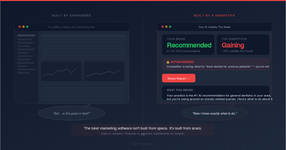
Why Marketing Software Built by a Marketing Professional Is Different


I spent years buying marketing software. Almost all of it was built by engineers who had never run a campaign, defended a budget, or presented results to a CEO who didn't care about click-through rates. You could feel it every time you logged in.
The moment I realized something was wrong
Picture this. It's 4pm on a Thursday. Your CEO walks over and asks: "Is our marketing working?"
You know the answer is yes. You can feel it. The phone is ringing more. The website traffic is up. Leads are coming in. But you can't prove it — at least not in one sentence, not without pulling up three different dashboards and spending an hour connecting the dots.
So you say something vague. Your CEO nods politely. And you spend the rest of the evening wishing your tools could just tell you the answer in plain English.
Built from the Trenches
I've been in that exact moment more times than I can count. And here's what I eventually realized: the problem wasn't me. The problem was that the tools I was using were designed by people who had never been in that moment.
Insights That Drive Action
"The best marketing software isn't built from specs. It's built from scars."
The engineers who built those tools were brilliant. The code was clean. The features were impressive. But the tools were built to display data — not to answer questions. And for a marketer, that's the difference between a tool that helps and a tool that creates homework.
Data vs. answers: the problem with most GEO tools
Let me get specific. Right now, there's a new category of marketing software called GEO — generative engine optimization. These tools track whether your brand shows up when people ask ChatGPT, Perplexity, Gemini, or Claude for recommendations.
This matters because more and more customers are skipping Google entirely. Instead of searching "best dentist near me," they're opening ChatGPT and saying "I haven't been to the dentist in three years and I'm embarrassed — who should I go to?" If your practice isn't in that AI answer, you're invisible.
So GEO tools exist to help you see where you stand. The problem is, most of them show you data when what you need are answers.
Here's what I mean:
The first one is accurate. The second one is useful. Most GEO platforms give you the first. Very few give you the second.
And it's not just about the words on screen. It's about the whole experience. Here are some everyday frustrations I kept running into:
Most GEO tools let you export raw data to a CSV. That's not a report — that's a homework assignment. I need something I can email to my CEO in 30 seconds that makes our AI visibility clear. A PDF. A link. Something with context, not just numbers.
A tool tells me our brand was mentioned in 6 out of 10 AI conversations about personal injury lawyers in our city. Great. But is that good? Is our competitor at 8 out of 10? Was it 4 out of 10 last month? Without that context, the number means nothing.
Knowing that you're not showing up in AI answers is step one. But what's step two? Most tools stop at the diagnosis. They don't tell you why you're missing, what content would help, or what your competitor is doing differently that AI likes better.
These aren't edge cases. This is every marketer's Tuesday.
Who's building GEO tools right now
The GEO space has exploded in the past year. Gartner is forecasting that traditional Google search traffic will drop 25% by 2026 because of AI assistants, so everyone is scrambling to build tools for this new world. Here's a quick lay of the land:
The big enterprise platforms. Profound raised $35M from Sequoia Capital. Evertune raised $19M. Both track 10+ AI engines and offer deep analytics. They're powerful and expensive — built for Fortune 500 companies with dedicated teams to run them.
The mid-range options. Goodie AI bundles monitoring, optimization, and content tools together. Gauge (backed by Y Combinator) focuses on competitive benchmarking. Peec AI offers clean dashboards with sentiment tracking. These are solid tools for teams that have the time to dig in.
The entry-level tools. Otterly.AI (named a Gartner Cool Vendor) starts at $25/month for basic monitoring. Semrush added GEO tracking to its existing SEO toolkit. HubSpot offers a free one-time AI Search Grader. Good starting points to see if GEO matters for your business.
These are all legitimate tools solving real problems. But here's the thing they almost all have in common: they were built by engineers or data scientists, then sold to marketers.
None of them were built by someone who spent years in the marketer's chair, felt the pain firsthand, and said "I'm going to build the tool I wish I had."
Want to see what AI says about your brand right now?
Get a free AI visibility snapshot — we'll show you exactly how ChatGPT, Gemini, and Perplexity talk about your brand today.
Get Your Free AI Snapshot →Why we built our own
Before I started Aethon AI, I was in sales and marketing. Not managing a team of 50. Not at a Fortune 500. I was in the chair — running campaigns, making calls, trying to prove results to people who were skeptical that marketing mattered at all.
When AI search started taking off, I noticed something: customers were finding brands through ChatGPT and Perplexity before they ever opened Google. But I had no way to see what AI was saying about us, or about our competitors.
So I did what any frustrated marketer would do. I opened ChatGPT and started typing prompts manually. "Who's the best provider for X in Y city?" Over and over. Copying the answers into a spreadsheet. Trying to spot patterns.
It worked — sort of. I could see that competitors were getting recommended and we weren't. But it took hours. And I could never be sure if what I was seeing was consistent or just random.
I looked for a tool that could automate this. The ones I found either cost thousands a month, required a PhD to understand, or just showed me data without telling me what to actually do.
So we built Aethon AI.
Not from a product spec. Not from a fundraising pitch deck. From the spreadsheet I was already keeping — the one where I manually tracked what AI was saying about our brand every week.
What we do differently
When you build software from your own frustration instead of a market analysis, you make different choices.
We show you the answer first, not the data. When you log in, you don't see a wall of charts. You see: "Here's what changed this week. Here's what needs your attention. Here's what's working." If you want to dig into the data behind it, you can. But the first thing you see is the thing you'd actually tell your boss.
We compare you to your competitors automatically. Every number has context. You're not just seeing your brand's AI visibility — you're seeing it next to your top three competitors, with trends over time. So when your CEO asks "are we winning?" you have an answer.
We tell you what to do, not just what happened. If ChatGPT is recommending your competitor for a specific type of customer, we don't just flag it. We show you why — what content they have that you don't, what questions customers are asking that you haven't addressed, and what steps would help you show up in that conversation.
We make sharing dead simple. One click to generate a report your CEO will actually understand. No spreadsheet wrangling. No screenshot stitching. A clean summary that says: here's where we stand in AI search, here's what's changing, and here's what we're doing about it.
We speak English, not analytics. No "citation density" or "prompt coverage ratios." Our interface uses the same words you'd use in a meeting: "You're being recommended here. You're missing here. Your competitor is ahead here. Here's why."
"I don't want a tool that makes me feel stupid for not understanding it. I want a tool that makes me look smart for using it."
That's the line I kept coming back to when we were building this. Every design decision runs through that filter. If a marketer needs to Google how to use a feature, we failed. If a marketer can't explain what the tool showed them in a 30-second hallway conversation with their boss, we failed.
We're not building for data scientists. Our goal isn't to build for enterprise GEO teams. We're building for the marketer at a dental practice, a law firm, a home services company, or a growing agency who knows AI search matters but doesn't have six figures to spend figuring it out.
Instead, this is the tool we wished existed. And now it does.
Frequently asked questions
What is a GEO platform?
GEO stands for generative engine optimization. A GEO platform tracks whether your brand shows up when people ask AI assistants like ChatGPT, Perplexity, Gemini, or Claude for recommendations. Think of it like SEO — but for AI instead of Google.
How is Aethon AI different from Profound, Evertune, and other GEO tools?
Most GEO tools are built by engineers for large enterprises. Aethon AI is built by marketers for small and mid-sized businesses. We focus on plain-language answers instead of raw data, easy sharing instead of CSV exports, and clear next steps instead of dashboards you need a data scientist to read.
Why does it matter who builds a GEO tool?
Because the builder's perspective shapes every decision. An engineer asks "what data should we show?" A marketer asks "what question is someone trying to answer?" That difference shows up in every screen, every report, and every feature.
What GEO platforms are available right now?
Enterprise: Profound (Sequoia-backed, $35M raised) and Evertune ($19M raised). Mid-market: Goodie AI, Gauge (YC-backed), Peec AI. Entry-level: Otterly.AI ($25/mo), Semrush AI Toolkit, HubSpot AI Search Grader (free). Aethon AI is built specifically for small to mid-sized businesses and marketing teams.
Do I still need this if I already use SEO tools like Ahrefs or Semrush?
Yes. SEO tools track Google rankings. They don't track what ChatGPT, Perplexity, or Claude say about your brand when customers ask for recommendations. Gartner estimates traditional search traffic will drop 25% by 2026 because of AI — so the channel you're not tracking is the one that's growing fastest.
Book a Demo
See How AI Talks About Your Brand
Get a personalized walkthrough of how Aethon AI tracks, optimizes, and grows your brand’s presence across ChatGPT, Gemini, Perplexity, and more.
Book a Demo →Stay ahead of AI search
Get weekly insights on GEO, AI visibility, and how to show up when AI answers life's big questions. Join marketers and founders who are already optimizing for the AI era.
Subscribe to the Newsletter →