
ChatGPT Brand Monitoring: How to Track What ChatGPT Says About Your Brand
ChatGPT brand monitoring is the practice of tracking whether, when and how ChatGPT names your brand, so you can see what buyers are being told and fix it when it is wrong.
What is ChatGPT brand monitoring?
ChatGPT brand monitoring is the practice of tracking whether, when and how ChatGPT names your brand in answers to the questions your buyers ask.
It covers four things: whether you appear at all, where you sit among the brands named, how the answer frames you, and whether the facts it states about you are correct. A ChatGPT brand tracker is software that runs those questions on a schedule and records the results, along with the citations behind each answer.
Why does monitoring brand mentions in ChatGPT matter?
Because buyers now ask ChatGPT what to buy, who to hire and which brand to trust, and the answer they get is a recommendation, not a page of links.
A search results page gives ten chances to be seen. A ChatGPT answer usually names a handful of brands, often fewer. If you are not monitoring brand mentions in ChatGPT, you have no idea whether the most-used AI assistant is recommending you, ignoring you, or describing you incorrectly to the people closest to a purchase.
What should you track in ChatGPT answers?
Track four signals for every question: presence, position, framing and facts. A brand can be mentioned and still lose if the framing is lukewarm or the facts are wrong.
| Signal | The question it answers | Why it matters |
|---|---|---|
| Presence | Did ChatGPT mention your brand at all? | No mention means you are not in the buyer's consideration set. |
| Position | Where do you sit among the brands named? | The first brands named get most of the attention. |
| Framing | Were you recommended, merely listed, or mentioned with a caveat? | A confident recommendation beats a lukewarm mention. |
| Facts | Is what ChatGPT says about you correct? | Wrong pricing, features or locations cost deals you never see. |
Whenever ChatGPT retrieves from the web, log the sources it cites as well. Those sources are the levers you can actually pull.
How do you track brand mentions in ChatGPT, step by step?
Build a fixed question set, run it on a schedule in fresh conversations, and log the same four signals every time. A spreadsheet and discipline are enough to produce a usable baseline.
- Build the question set. Write 20 to 50 questions your buyers really ask, from category questions to the life moments that create demand in the first place.
- Use fresh conversations. Start a new chat for each run so earlier context does not shape the answer.
- Vary the phrasing. Use several wordings per question, because small changes in phrasing can change which brands are named.
- Log every brand named. Record position and framing for you and for competitors, plus the cited sources when ChatGPT retrieves from the web.
- Repeat on a schedule. Monthly is the minimum for a manual program. Keep the questions constant so trends are comparable.
- Trace each lost mention to its sources. The pages ChatGPT read instead of yours tell you what to fix.
Do you need a tool, or can you monitor ChatGPT mentions manually?
You can start manually. A ChatGPT mentions monitoring tool automates the same loop: ask the questions your buyers ask, record where your brand appears, repeat on a schedule. It earns its subscription when you need scale and memory.
| Manual workflow | Monitoring tool | |
|---|---|---|
| Best for | A first baseline | An ongoing program |
| Scale | 20 to 50 questions | Hundreds of questions |
| History | A spreadsheet you maintain | Automatic trend lines |
| Competitors | Logged by hand | Tracked on identical prompts |
| Sources | Noted when visible | Source changes tracked over time |
| Alerts | None | When your mention rate or framing moves |
Manual checks drift, because model answers change with every update and nobody re-runs fifty questions by hand every week. Whichever route you choose, the step most programs skip is the one that changes outcomes: connecting each lost mention to the sources behind it and fixing them.
Is there a tool that shows what ChatGPT says about your company?
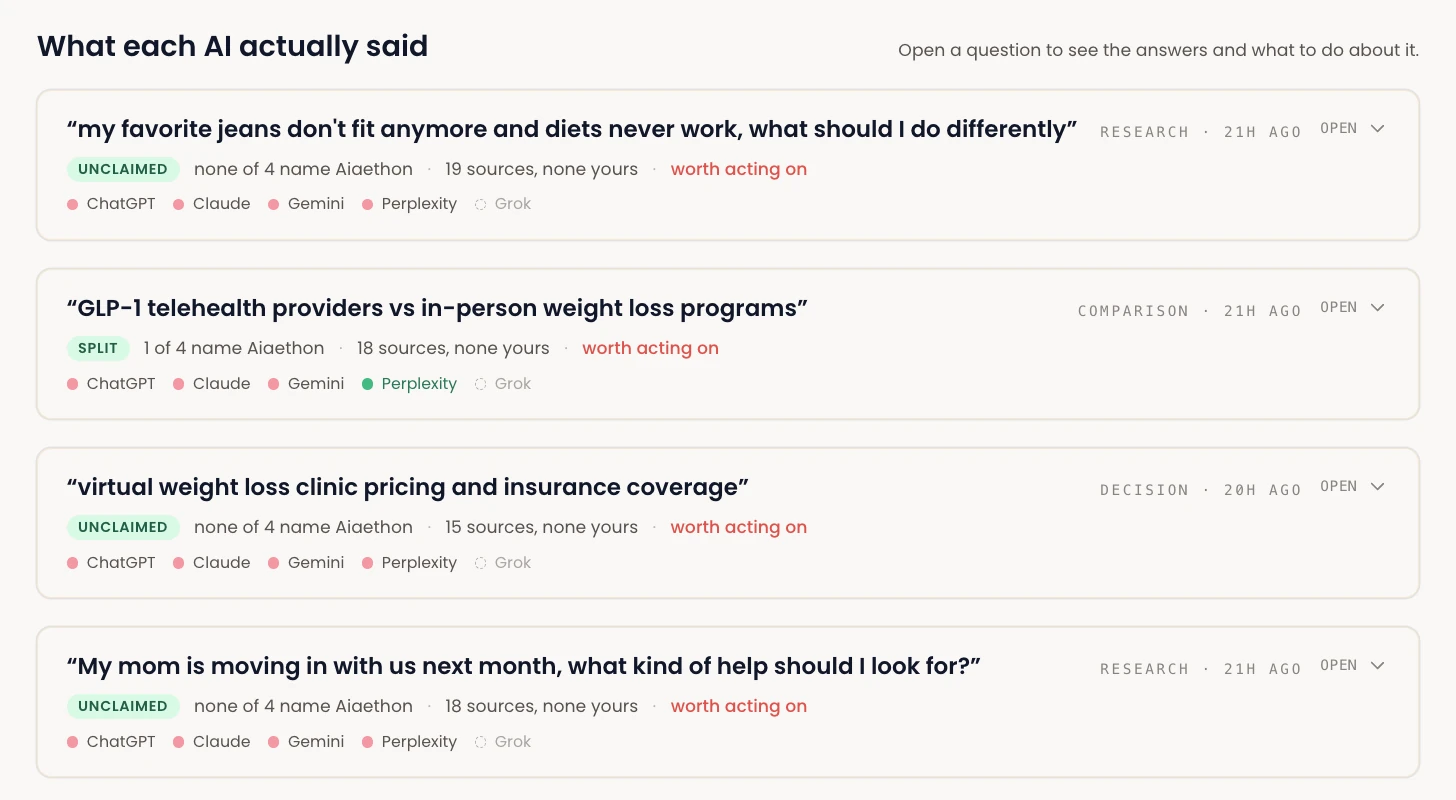
Yes. Aethon's AI Answer Monitoring runs your buyers' questions across ChatGPT, Claude, Gemini and Perplexity and keeps every answer, so you can read exactly what each assistant said.
For each question you see which assistants named you and which did not, who was named instead, how many sources were read and whether any of them were yours. Appearance is counted from the answers themselves, so every figure can be checked against the text behind it.
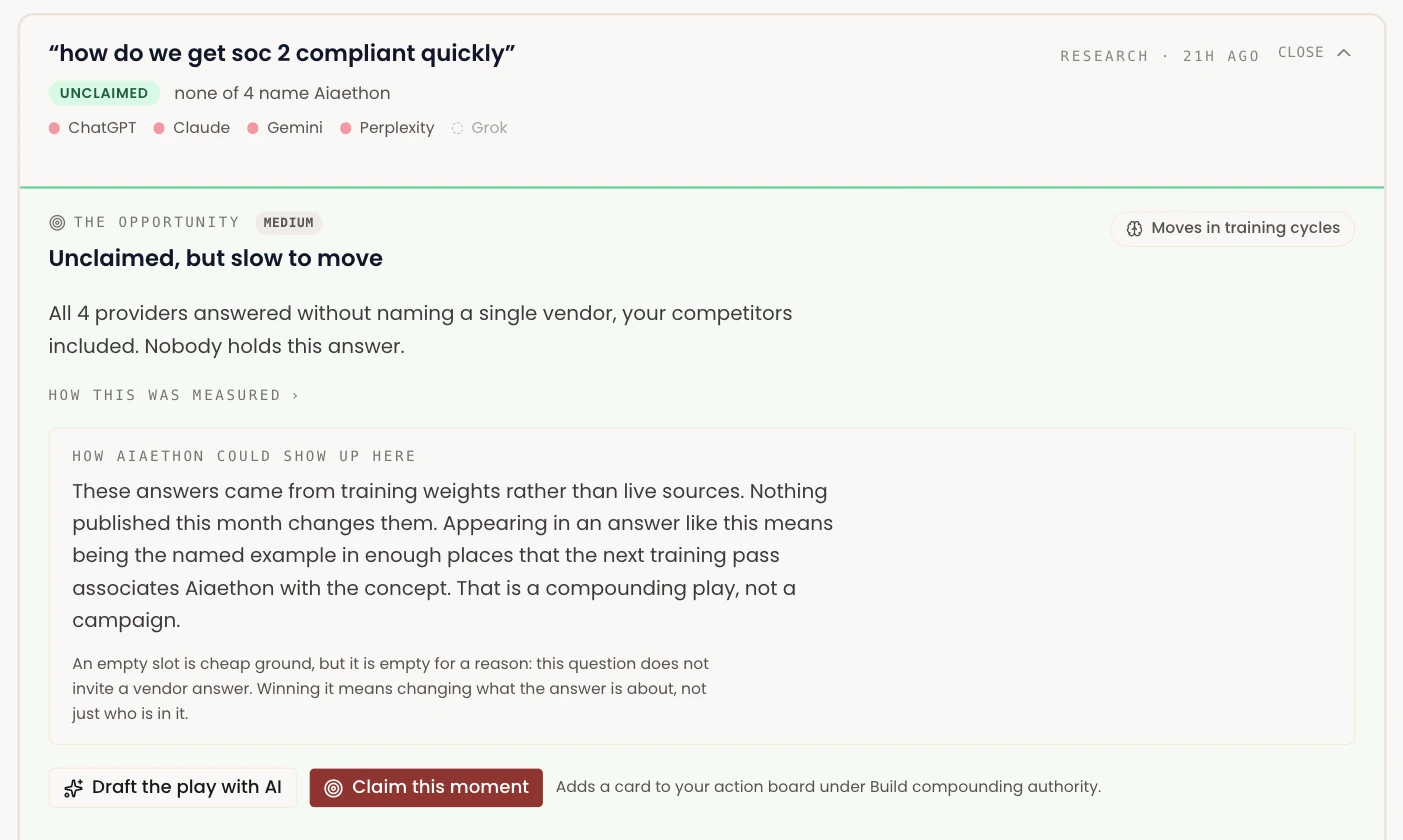
Open any question and Aethon explains the opportunity in plain English: whether the slot is held by a competitor or unclaimed, and whether the answer came from live sources that can move in weeks or from training memory that moves more slowly.
See how AI Answer Monitoring works or book a demo to run your own questions live.
Can you monitor ChatGPT brand mentions in real time?
Not literally. Private conversations are not visible to anyone, so no tool can watch real users' chats as they happen.
The honest equivalent is high-frequency sampling: scheduled runs of your buyer questions, with alerts when a mention, a framing or a citation changes. That catches shifts within days. Because model answers shift with every update, continuous re-checking beats a one-off audit.
How do you track brand performance in ChatGPT responses over time?
Keep the question set constant, log mention rate, position and sentiment on every run, then split the data three ways. Raw mention counts hide the story.
- By answer mode. Mentions that come from training data move slowly. Mentions from live browsing respond to source fixes within weeks. Trend them separately.
- By moment. A mention in a casual definition answer is worth less than a recommendation at a buying moment. Share of voice on high-intent questions is the number to watch.
- By competitor. Comparing competitors on identical prompts turns your dashboard from a mirror into a map. It shows which answers are winnable and which sources, such as review platforms, comparison articles and structured data, are doing the winning.
What is the difference between ChatGPT brand monitoring and AI brand monitoring?
ChatGPT brand monitoring tracks one assistant. AI brand monitoring covers every assistant your buyers use: ChatGPT, Claude, Gemini and Perplexity.
The distinction matters because the assistants pull from different sources and often give different answers to the same buying question. A brand that looks strong in ChatGPT can be invisible in Perplexity. A complete program has three layers: AI prompt monitoring to know which questions matter, tracking brand mentions in AI search to know where you stand, and AI brand visibility work to change the answers.
For the other assistants, see Perplexity brand monitoring and Gemini brand monitoring.
How do you go from monitoring to changing what ChatGPT says?
Monitoring tells you what is being said. It does not change it. The answer changes when the sources behind it change.
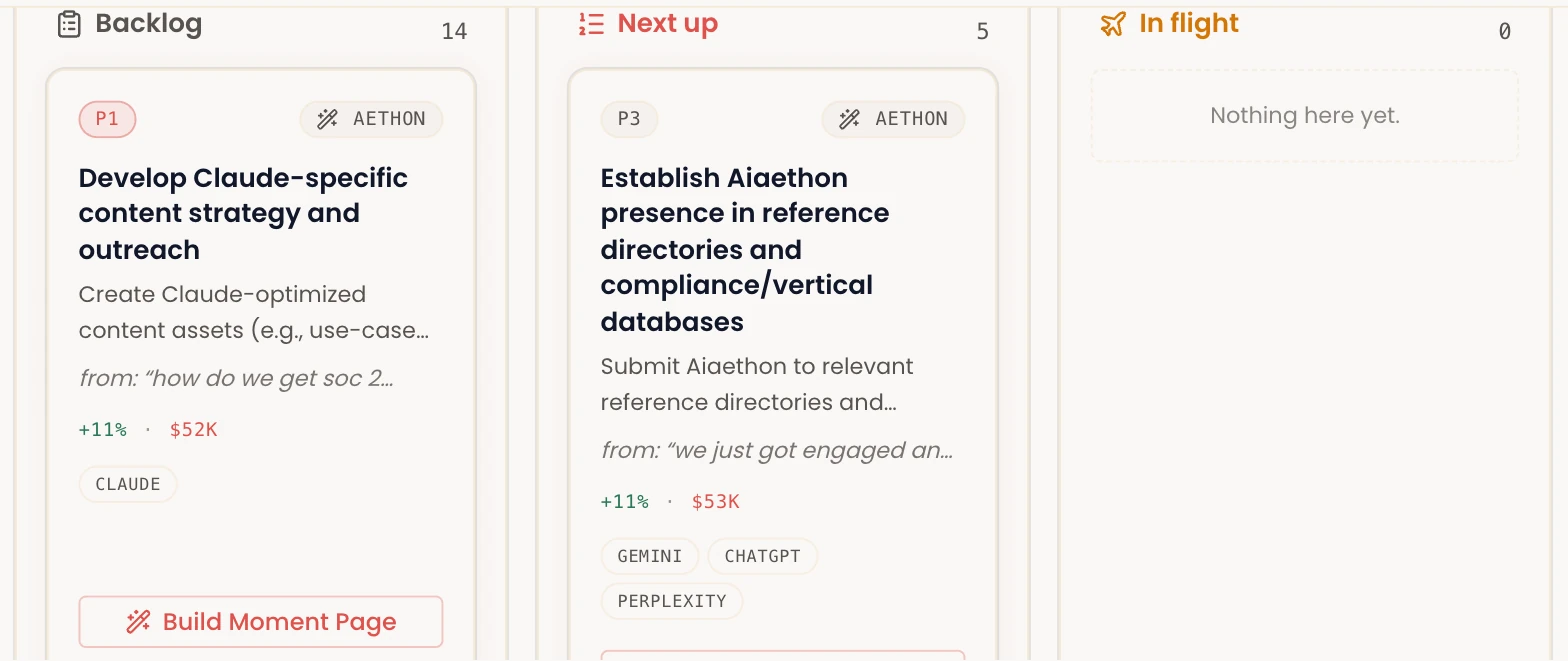
For every lost mention, find the pages ChatGPT read, then decide whether to create a source, strengthen one you own, or earn a place on one you do not. Aethon pairs continuous tracking across all four assistants with an Action Engine that turns each gap into a ranked action with the expected lift and the revenue behind it.
Frequently asked questions
How do you check your brand's visibility in ChatGPT for free?
What is a ChatGPT brand tracker?
Are there ChatGPT brand visibility services?
How often should you re-run your ChatGPT questions?
Should you monitor Gemini, Claude and Perplexity as well as ChatGPT?
See what ChatGPT says about your brand.
Bring your brand to a 30-minute demo and we run your top questions through ChatGPT, Claude, Gemini and Perplexity, live.